
The question of who is responsible for providing gloves is one of the most basic, and surprisingly common and ongoing issues caregivers with an agency face.
If you’ve worked in home care long enough, you’ve likely encountered different answers depending on the agency, the client, or even the situation on a given day. Some agencies provide gloves consistently. Others shift that responsibility to the client’s family. And in far too many cases, caregivers find themselves quietly supplying their own just to ensure the job gets done safely.
This article takes a clear, grounded look at the issue from multiple angles—professional standards, agency expectations, and real-world practice—while inviting you to reflect on your own experiences.
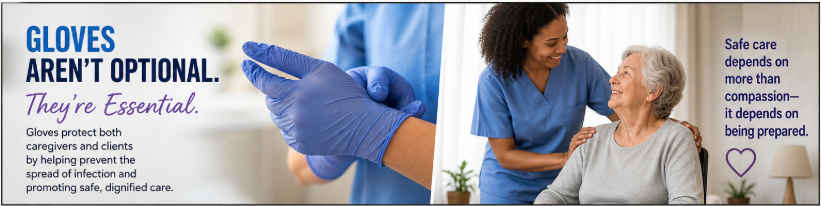
Why Gloves Are Not Optional
Before discussing responsibility, it’s important to establish one thing:
Gloves are not a convenience. They are a necessity.
In caregiving, gloves are part of everyday protective practice. Whether assisting with personal hygiene, handling bodily fluids, performing peri-care, or managing incontinence, gloves protect both the caregiver and the patient.
They are directly tied to:
- Infection control
- Standard precautions
These are not advanced or optional concepts. On the contrary, they are foundational principles in healthcare. From hospitals to home care, they exist to prevent the spread of infection and ensure safety in every interaction.
Without gloves, caregivers are placed in a position where they must choose between:
- Compromising safety
- Or refusing care
Neither is acceptable in a professional setting.
The Three Common Models in Home Care
Across agencies and private arrangements, glove responsibility typically falls into one of three models:
1. Agency-Provided Supplies
In some agencies, gloves and other PPE are supplied directly by the company. This is often seen in:
- Skilled home health services
- Hospice organizations
- Larger, well-structured agencies
In these settings, gloves are treated as part of operational overhead—just like training, scheduling, and documentation systems.
Advantages:
- Consistency of supply
- Reduced confusion
- Alignment with healthcare standards
Challenges:
- Delivery delays
- Limited quantities
- Reliance on agency coordination
2. Client/Family-Provided Supplies
This is one of the most common models in non-medical home care.
The agency states upfront (or sometimes only when asked) that:
“The family is responsible for providing gloves and supplies.”
In theory, this makes sense. The supplies are used in the client’s home, for their care.
Advantages:
- Supplies remain on-site
- No dependency on agency delivery schedules
- Cost is tied directly to the care recipient
Challenges:
- Families may forget or delay restocking
- Patients with memory challenges may be unable to manage supplies
- Caregivers may be left without essentials mid-shift
3. Caregiver-Supplied (Unofficial Reality)
While rarely stated outright, this becomes the default reality in many cases.
When:
- The agency doesn’t provide
- The family forgets or delays
- And care still must be delivered
The caregiver steps in.
Quietly. Consistently. At their own expense.
Advantages:
- Immediate access
- No interruption in care
Challenges:
- Financial burden on the caregiver
- Lack of reimbursement
- Normalization of an inappropriate expectation

The Ethical Question: Who Should Be Responsible?
From a professional and ethical standpoint, the responsibility should never fall solely on the caregiver.
Here’s why:
1. Caregivers Are Not Independent Supply Chains
Even when working privately, caregivers are hired for their skills, time, and expertise—not to absorb operational costs.
Providing your own gloves may seem small at first, but over time it becomes:
- A recurring expense
- An unacknowledged expectation
- And a silent erosion of professional boundaries
2. Agencies Set the Structure
Agencies establish the terms of care.
If an agency chooses a model where the family provides supplies, then it is the agency’s responsibility to:
- Communicate that clearly upfront
- Reinforce it with the family
- Ensure accountability
When agencies fail to address this proactively, the burden shifts downward to the caregiver.
3. Patients May Not Be Able to Manage Supplies
In many caregiving situations, patients:
- Have memory challenges
- Are physically limited
- Depend on others for daily needs
Expecting them to consistently manage glove supplies is often unrealistic.
This is where family involvement—or agency oversight—becomes essential.
The Real-World Gap Between Policy and Practice
On paper, things may seem straightforward:
- Agency: “Family provides supplies.”
- Family: “We’ll get them.”
But in reality:
- Deliveries are delayed
- Instructions are forgotten
- Communication breaks down
And the caregiver—standing at the bedside—must still perform the task at hand.
This is where professionalism meets practicality.
Experienced caregivers often:
- Adapt quickly
- Fill in gaps
- Keep care moving forward
But adaptation should not be mistaken for obligation.

A Professional Approach to Handling the Situation
Without escalating conflict or prolonging unnecessary discussions, caregivers can navigate this issue with clarity and structure.
A balanced approach includes:
- Clarifying responsibility with the agency
- Informing the patient or family when supplies are low
- Documenting or noting the need in shared communication tools
- Maintaining personal standards of care
This keeps the focus where it belongs—on safe, consistent care—while still reinforcing appropriate boundaries.
The Financial Reality Caregivers Face
Let’s address something often overlooked.
Gloves may seem inexpensive individually. But over time:
- Multiple pairs per shift
- Several shifts per week
- Weeks turning into months
The cost adds up.
For caregivers already working long hours—often under unpredictable schedules—this becomes another layer of unrecognized expense.
It raises an important question:
Should caregivers be subsidizing the basic costs of care?
Where Do We Go from Here?
There is no one-size-fits-all answer, but there is a need for clearer standards.
Ideally:
- Agencies would define supply responsibility upfront
- Families would understand and follow through
- Caregivers would not be placed in the middle
Until then, the issue remains a shared gray area—navigated daily by those doing the work.
Let’s Talk About It
This conversation is long overdue, and your voice matters.
If you are a caregiver:
- Have you ever had to provide your own gloves?
- How often does this happen in your experience?
- Do your agencies address this clearly—or only when asked?
If you are a family member:
- Were you informed that you are responsible for supplies?
- Has this ever been unclear or inconsistent?
If you work for or run an agency:
- How do you handle PPE responsibilities?
- What systems are in place to prevent caregivers from being left without essentials?
Final Thoughts
At its core, this issue goes deeper than gloves. It highlights:
- Professional standards
- Clear communication
- Respect for the caregiver’s role
Every interaction in caregiving leaves an imprint—on safety, dignity, and trust.
And something as simple as a box of gloves can say a lot about how that care is structured.
Your Turn:
Share your experience, your perspective, or your approach.
Because when we talk about these everyday realities, we bring clarity to a system that needs it.
Veron Percy-Jarrett | Caregiver with over 19 years’ experience
Toll-free: 1 (888) 670-6053 | veron@theway4word.com