
In caregiving, teamwork is often spoken about—but not always practiced. This is where the SOULINK™ Framework together with the Imprint Principle bring clarity.
After nearly two decades as a nurse aide and caregiver, I have experienced both sides: environments where teamwork flows naturally, and others where it feels strained, transactional, and at times, divisive.
Recently, I revisited the concept of teamwork. What stood out to me was not just what was written. More importantly, it showed how closely it aligned with what I have already lived when teamwork is done right.
In this article, we’ll take a closer look at what teamwork should look like in caregiving. In contrast, we’ll see what happens when it’s replaced by task-based thinking.
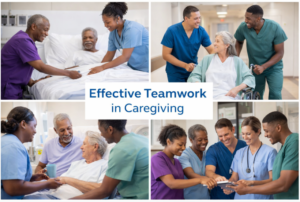
Redefining Teamwork in Caregiving | Person-Centered
A true caregiving team is not simply a group of individuals completing assigned duties.
Instead, a team is:
- A group of nurse aides, CNAs, and caregivers who operate with a shared purpose centered on the patient
- Individuals who remain aware of each other’s responsibilities while stepping in when needed
- Care providers who communicate in real time—not just at shift change
- Professionals who balance responsibility with flexibility
- A unit that understands that patient care does not always follow a rigid clock
Teamwork is not only about who did what.
On the contrary, it is about ensuring the patient’s needs are met—with dignity, efficiency, and respect.
A Real-Life Contrast | Teamwork vs Task Work
Earlier in my career, working alongside fellow Jamaican caregivers, teamwork was almost unspoken—but consistently practiced.
If I was still attending to a patient at shift change and the bed was not made, the incoming caregiver would step in without hesitation. Either she would assist with the patient or complete the task independently.
There was no accusation.
Neither tallying of duties.
Nor assumption of neglect.
Instead, there was understanding.
We recognized that:
- Patient care comes first
- Timing may shift based on patient needs
- We are part of the same team with the same goal
Recently, I encountered the opposite.
While honoring a patient’s request regarding timing, a routine task extended beyond my shift. The incoming caregiver had already been asked by the patient to complete it afterward. However, the situation was framed as “unfair” to the next caregiver.
In that moment, the focus shifted:
- From patient-centered care → to task ownership
- From collaboration → to comparison
- From teamwork → to division
This is where the breakdown occurs.

SOULINK™ Framework in Action | Teamwork That Works
When applied to teamwork, the SOULINK™ Framework transforms how care is delivered:
S – Stewardship
Each caregiver understands that their role is not ownership of tasks—but responsibility for outcomes. The patient’s well-being is the priority.
O – Opportunity
Every shift change is an opportunity to support, not scrutinize. A chance to strengthen the team rather than divide it.
U – Understanding
Situations are evaluated in context. Was the caregiver actively engaged in care? Was the patient’s preference honored? Understanding replaces assumption.
L – Life (Center)
The patient is at the center—not the task list, not the clock, not the caregiver’s convenience.
I – Intentionality
Caregivers act with purpose. Helping a coworker is not an obligation—it is a conscious decision to uphold quality care.
N – Nurture
A supportive environment is cultivated where caregivers feel respected, not monitored or judged.
K – Knowledge
Experience teaches that care is dynamic. No two shifts are identical, and flexibility is essential.
Qualities of an Effective vs Ineffective Caregiving Team
An effective team of nurse aides and caregivers demonstrates:
- A shared commitment to patient-centered care above rigid task completion
- Open, respectful communication before, during, and after shifts
- Willingness to assist without being prompted
- Trust in each other’s professional judgment
- Flexibility when patient needs alter timing or routine
- Mutual respect regardless of experience level or background
- A calm, supportive atmosphere where caregivers feel valued
- Collective problem-solving when challenges arise
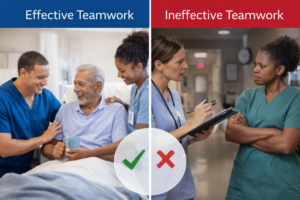
An ineffective team often reflects the opposite:
- Focus on task completion over patient needs
- Minimal or one-sided communication
- Reluctance to assist coworkers
- Assumptions made without full context
- Rigid adherence to schedules without flexibility
- Tension or competition between caregivers
- Lack of trust or respect within the team
- Problems escalated instead of resolved collaboratively
When Systems Undermine Teamwork
It must be acknowledged that sometimes the breakdown in teamwork does not begin with caregivers—it begins with the system.
Some agencies unintentionally contribute to ineffective teamwork by:
- Emphasizing task-based care without reinforcing team-based collaboration
- Framing responsibilities in a way that discourages flexibility
- Failing to provide clear, detailed care plans
- Leaving caregivers to interpret expectations without guidance
- Addressing concerns in ways that create division rather than clarity
In some cases, there are no clear instructions in the care plan regarding timing, patient preferences, or task delegation. This creates gray areas where caregivers must rely on judgment—yet are later evaluated without consideration of context.
When structure lacks clarity, teamwork suffers.
Restoring What Teamwork Should Be | Unity
True teamwork in caregiving is not complicated—but it does require alignment:
- Alignment with the patient’s needs
- Alignment with each other
- Alignment with a shared purpose
As CNAs and caregivers, we do more than complete tasks.
We step into people’s lives at their most vulnerable moments.
That responsibility calls for more than skill—it calls for unity.

The Imprint We Leave | A Clear Principle
Caregiving is never neutral.
Every interaction—between caregiver and patient, and between caregiver and caregiver—leaves an imprint.
When teamwork is rooted in Stewardship, Opportunity, Understanding, Life, Intentionality, Nurture, and Knowledge, that imprint becomes one of dignity, respect, and excellence.
That is the standard.
That is SOULINK™ in action.
Conclusion | A SOULINK™ Teamwork Perspective
Teamwork in caregiving is not defined by perfectly completed task lists or rigid shift boundaries. It is revealed in the moments where caregivers choose understanding over assumption, support over division, and purpose over convenience.
At the same time, we must be honest—what is often labeled as teamwork in caregiving does not always reflect the reality.
When caregivers operate within systems that prioritize tasks over people, clarity over context, and policy over purpose, teamwork becomes strained. Not because caregivers are unwilling—but because the structure does not support what true teamwork requires.
Yet even within those systems, we still have a choice.
As nurse aides, CNAs, and caregivers, we are called to more than routine—we are called to alignment. Alignment with the patient, with each other, and with the deeper responsibility entrusted to us.
Through SOULINK™—Stewardship, Opportunity, Understanding, Life, Intentionality, Nurture, and Knowledge—we move beyond simply doing the work. We begin to elevate it.
Because at the end of the day, teamwork is not proven in convenience—it is revealed in how we respond when it is tested.
And in that response, we leave an imprint—not only on the lives of those we care for, but on the standard of care itself.
That is what teamwork should be.
Veron Percy-Jarrett | Caregiver with over 19 years’ experience
Toll-free: 1 (888) 670-6053 | veron@theway4word.com